What Information Should Be Delivered First in an Emergency?

Dctoral thesis works Duration: 08.2025 Design&Research Tools: User Survey, Figma
Project Background and Method
"What Information Matters Most in Emergency Alerts?"
One of the most important questions in designing emergency alerts is: “What information should be prioritized for users?” Among the various types of information included in emergency notifications, which elements do users consider most important, and what additional information would they like to receive? Although emergency alerts are a common part of daily life, there has been relatively little systematic research examining users’ information needs and the perceived importance of individual information elements.
To address this gap, this study evaluated the importance of information currently provided in emergency alerts and investigated user demand for new forms of disaster and safety information. Through this process, the study aimed to identify the information users consider most critical and to determine which additional information elements should be incorporated into future emergency alert systems.
Literature Review & Research Methodology
To identify the key information elements that should be included in emergency alerts, this study first examined both domestic and international emergency alert systems. During the literature review phase, emergency notification systems from countries located along the Pacific Ring of Fire—where natural disasters occur frequently—were analyzed and compared to understand how disaster-related information is delivered and structured across different regions.
To further investigate how language environments influence the communication of emergency information, user interviews were conducted with participants from countries that use two or more official languages. These interviews explored how emergency information is presented in multilingual contexts and identified potential issues related to translation and information comprehension. In addition, international interviews were conducted with individuals who had recently experienced natural disasters, allowing the study to gather firsthand insights into emergency alert usage and user information needs.
Based on the findings from the literature review and international interviews, a set of emergency alert information elements and user experience factors was established. A user study was then conducted using a five-point Likert scale to evaluate both the perceived importance of information elements and preferred information layout strategies. Mean scores and standard deviations were calculated to compare the relative importance of each information component.
The user study followed an ISO-based evaluation procedure and involved 250 participants in South Korea. Participants assessed the importance of various information elements commonly included in emergency alerts and evaluated multiple alert interface designs featuring different combinations of information and screen layouts.
Based on the findings, this study proposes design recommendations and information architecture guidelines for future mobile emergency alert systems, with the goal of improving information delivery and user comprehension during emergency situations.
International User Interviews
To examine how language environments affect the understanding of emergency alerts, interviews were conducted with users from both single-language and multilingual countries.
Three key findings emerged. First, some participants preferred English because it is an official or widely used language in their country, making it the most familiar language for receiving important information. Second, several participants used English even though it was not their native language, explaining that English often delivers information more concisely and efficiently than their native language.
Third, differences in vocabulary and writing systems affected information comprehension. Chinese-speaking participants noted that terminology varies across regions, making technical or disaster-related information difficult to interpret consistently. One participant stated that receiving information in the country's official language was sometimes more helpful than receiving a direct translation into their native language.
These findings suggest that emergency alert systems should consider not only multilingual support but also users' actual language environments and comprehension patterns when delivering critical information.
참여자/ Participant | 사용 모바일 / Mobile Device | 거주국 / Country of Residence | 주 사용언어/ Primary Language | 공용어/ Official Language |
T | 아이폰 /iPhone | 싱가포르 / Singapore | 중국어 Chinese | 영어, 중국어 English, Chinese |
A | 안드로이드 /Android | 싱가포르/ Singapore | 영어 Chinese | 영어, 중국어 English, Chinese |
E | 안드로이드 /Android | 필리핀/ Philippines | 영어 English | 타갈로그어, 영어 Tagalog, English |
D | 아이폰/ iPhone | 필리핀/ Philippines | 타갈로그어 Tagalog | 타갈로그어, 영어 Tagalog, English |
K | 아이폰, 안드로이드/ iPhone, Android | 한국/ South Korea | 한국어 Korean | |
M | 안드로이드/ Android | 태국 /Thailand | 태국어 Thai | |
R | 아이폰/ iPhone | 일본/ Japan | 일본어 Japanese | |
C | 아이폰/ iPhone | 인도네시아 /Indonesia | 인니어 Indonesian | |
B | 아이폰/ iPhone | 대만/ Taiwan | 중국어 Chinese | |
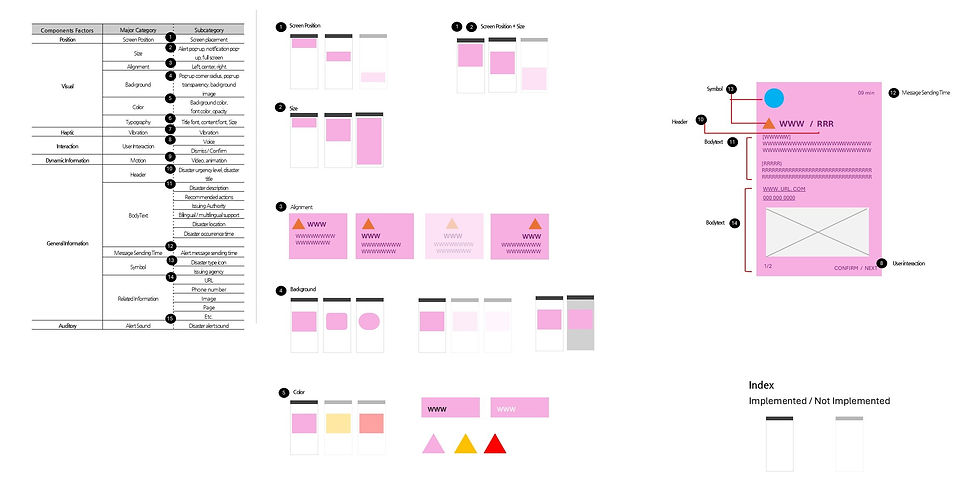
International Emergency Alert Types and Components Through international case studies and user interviews, various types of emergency alert systems and their information structures were identified. The analysis revealed common alert components, screen layouts, and information elements used across different countries.
Usability Evaluation
Using the components identified through the literature review and international interviews, multiple emergency alert concepts were developed and evaluated with users. An ISO-based usability assessment was conducted to identify the most effective information hierarchy, screen layout, and content composition for emergency alerts.

Reliability of the User Survey Instrument
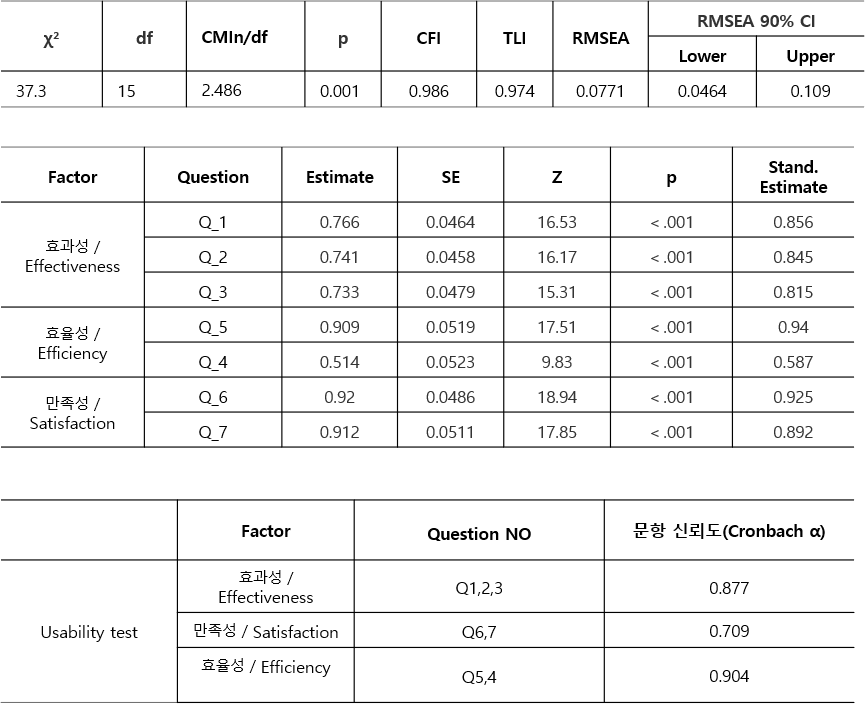
To evaluate the usability of emergency alert designs, survey items were developed based on the ISO usability dimensions of Effectiveness, Efficiency, and Satisfaction. The questionnaire was adapted to reflect the context of emergency alert systems while maintaining alignment with established usability evaluation criteria.
Reliability analysis was conducted using Cronbach’s Alpha. The results indicated a high level of internal consistency across the measurement items. In particular, both the Effectiveness and Efficiency dimensions achieved Cronbach’s Alpha values above 0.90, demonstrating excellent reliability and suggesting that the survey items consistently measured the intended constructs.
For this reason, the survey instrument was considered sufficiently reliable for evaluating user perceptions of emergency alert information and interface designs.
Participant Demographics
The user study was conducted with participants from a wide range of demographic and occupational backgrounds to ensure diverse perspectives. Since emergency alerts serve as a form of public safety communication intended for the entire population, the study sought to include users with different levels of experience, occupations, and accessibility needs.
In particular, participants with disabilities were included in the evaluation to better reflect the diversity of real-world users. This approach helped ensure that the findings considered accessibility and inclusiveness, which are essential requirements for public emergency alert systems. By incorporating a broad range of user groups, the study aimed to develop emergency alert guidelines that are effective and understandable for as many people as possible.

Results: Information Importance Evaluation
The first phase of the study examined the perceived importance of individual information elements included in emergency alerts. Participants were presented with each information component and asked to rate its importance using a five-point Likert scale.
The results showed that Severity Level (M = 4.18, SD = 0.71) and Alert Summary (M = 4.18, SD = 0.69) received the highest ratings among all information elements. These were followed closely by Action Guidance Banner (M = 4.17, SD = 0.77) and Recommended Actions (M = 4.12, SD = 0.75), indicating that users place high value on information that helps them quickly understand both the level of danger and the actions required.
Traditional emergency alert components such as the Alert Icon (M = 4.02, SD = 0.78) and Hazard Type Summary (M = 3.99, SD = 0.77) were also regarded as important by participants. In contrast, Alert Time (M = 3.96, SD = 0.86), Sender (M = 3.55, SD = 0.96), and Related Links (M = 3.52, SD = 0.87) received comparatively lower scores. Nevertheless, all information elements achieved mean scores above 3.5, suggesting that each component contributes meaningful value within the overall structure of an emergency alert.
Overall, the findings indicate that users prioritize information that immediately communicates the severity of the situation and the actions they should take, while contextual information such as the sender, timestamp, and supplementary links is perceived as secondary.


Design Recommendations
-Emergency Alert Screen Layout-
Based on the research findings, a proposed emergency alert interface was developed to improve information delivery and readability across different languages and devices.
To support multilingual environments, Pretendard was selected as the primary typeface. When defining text areas, the maximum character capacity was calculated using the uppercase letter “W”, which generally occupies the widest horizontal space in Latin-based languages. This approach ensured that text containers could accommodate content consistently across different languages and character widths.
To maintain visual consistency across a wide range of device sizes and screen resolutions, center alignment and vector-based layout principles were adopted as core design rules. These guidelines help preserve readability and interface stability regardless of device specifications.
The maximum text allocation for each information component was defined as follows:
Alert Summary: 10 characters
Recommended Action: 16 characters
Incident Time: 21 characters
Alert Message Body: 88 characters
Translate / View Original Button: 8 characters
Alert Timestamp: 5 characters
Because these limits were calculated using the widest character width, the actual number of visible characters may be greater depending on language, spacing, and character composition. This design approach provides sufficient flexibility while maintaining a clear and consistent information hierarchy across multilingual emergency alert systems.


Analysis of international emergency alert systems revealed that many alerts contain redundant information or overly detailed explanations, resulting in excessively long messages. In some cases, alerts occupied more than half of the screen or required users to expand collapsed content to view the full message.
Such lengthy messages can reduce the perceived urgency of an alert and increase the likelihood that critical information will be overlooked. This issue becomes even more significant for users with slower reading speeds, including children, older adults, and individuals with visual impairments.
To address this problem, this study proposes an AI-powered alert summarization feature. Upon receiving an emergency alert, the system automatically identifies the most critical information and presents a concise summary of the situation along with the immediate actions users should take.
In addition, the system provides hazard-specific pictograms to improve visual recognition and automatically extracts and displays the incident time when such information is included in the original alert message. This approach enables users to understand essential information more quickly and respond effectively during emergencies..
-Proposed Feature: Multilingual Emergency Alert Translation-
This feature automatically translates emergency alerts based on the user's preferred language settings. Key information is summarized and displayed in the selected language first, while the original message remains accessible through a “View Original” option.
Findings from the international interviews showed that users do not always configure their devices in their native language. Many participants used English as their primary mobile language because it is an official language, widely used in daily life, or easier for understanding technical information. As a result, emergency alert systems should not assume that the device language and the user's preferred language are always the same.
Therefore, the proposed design allows users to manually select their preferred translation language while supporting both translated summaries and full-message translation.
This feature is particularly valuable for international travelers, expatriates, and users living in multilingual environments. Emergency alerts are often distributed only in the local language, making it difficult for non-native speakers to quickly understand critical information. By providing immediate translation and summarized content, users can more rapidly comprehend the situation and take appropriate action during emergencies.
The concept was illustrated using a real earthquake alert issued in Taiwan on April 23, 2024. In this scenario, a Korean traveler receives the alert in Taiwan. The system automatically displays a Korean summary while preserving the original message, allowing users to switch between translated and original content as needed.

-Reduced Message Length Through Emergency Alert Translation -
This design scenario is based on the earthquake alert issued following the 2024 Hualien Earthquake in Taiwan. On April 3, 2024, at 7:58 AM, a magnitude 7.2 earthquake struck the Hualien region of Taiwan. The alert interface was reconstructed using an emergency notification message distributed to residents in Kaohsiung after the event.
The original alert issued by the Taiwanese government contained both Chinese and English text, resulting in a lengthy message. For this study, the alert was classified as a Level 4 Emergency and redesigned according to the proposed emergency alert guidelines.
The original message contained 354 characters including spaces (308 characters excluding spaces). In contrast, the proposed design reduced the displayed content to 137 characters including spaces by restructuring information into concise three-line sections and prioritizing essential information.
In addition, the proposed design presents a translated summary first, allowing users to quickly understand the situation without reading duplicated multilingual content. By reducing message length and improving information hierarchy, the design enables faster comprehension and more effective responses during emergency situations.
기존 알림 메시지 | 디자인 알림 제안 |
공백포함 354자 | 공백포함 137자 |
Emergency Warning / Emergency Warning 11:40 AM on June 20, 2025 Unidentified ignition gas has spread through the Hawker Center. All actions that may ignite, such as torches, gas ranges, cigarettes, and matches, are prohibited. Do not go out with windows closed. CEMS
緊急災難警報/緊急災難警報2025年6月20日11:40上午,不明起火氣體在霍克中心蔓延。 禁止噴燈、煤氣竈、香菸、火柴等一切可能起火的行爲。 關上窗戶,不要出門。 CEMS
| 위급 재난 문자 2024년 4월 3일 8:00 AM 위국가 경보 [지진속보] 01/21 00시 26분쯤 남부지방에서 큰 체감지진이 발생했습니다. 강한 흔들림에 주의하고 근처에서 대피하세요. 기상청에 따르면 "엎드리고, 가리고, 붙잡으세요."
지진 경보. 침착함을 유지하고 근처에서 엄폐물을 ... |
Reducing Emergency Alert Length Through Translation Features
-Information Hierarchy and Layout Guidelines for Emergency Alerts-
The type and amount of information included in emergency alerts vary depending on the responsible agency, disaster type, and emergency situation. As a result, a standardized approach is needed to determine which information should be displayed, in what order, and at what visual priority.
Based on the information importance evaluation, this study developed a set of guidelines for information hierarchy and layout design. Information elements that users identified as the most critical were prioritized and classified as essential information, with recommendations for their placement, visual prominence, and presentation method.
The proposed guidelines help ensure that the most important information is communicated first, allowing users to quickly understand the situation and take appropriate action during emergencies. By establishing a consistent information hierarchy, the design also improves readability and supports faster decision-making under time-sensitive conditions.
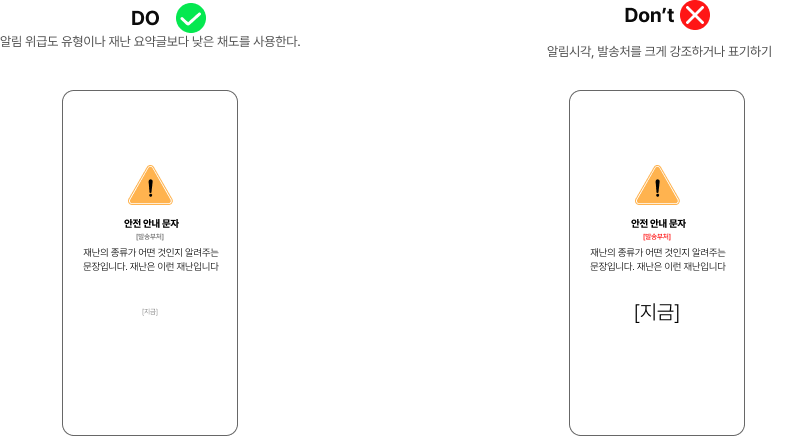
The severity level should receive the highest visual emphasis, allowing users to immediately recognize the urgency of the situation.

Action-oriented information should receive greater visual emphasis than descriptive message content to support immediate user response.

Titles and headings should always appear above their associated content.

Emergency information should remain within the upper half of the screen to ensure immediate visibility and accessibility.

Alert timestamps and sender information should not receive strong visual emphasis or occupy excessive screen space.
UX Insights
One of the key findings was that users strongly preferred information that allowed them to immediately identify the severity level of an emergency. Since visual warning icons are commonly used in emergency alerts, participants showed a clear preference for information that helped them quickly distinguish the urgency of a situation.
In contrast, government-provided links and supplementary information received relatively lower importance ratings. During the interviews, several participants stated that they tended to trust information they searched for themselves rather than information provided directly by government agencies. While this perception may reflect cultural characteristics specific to Korea, it suggests that users prioritize rapid access to actionable information over official references.
Participants consistently expressed a desire to quickly understand what happened, how serious the situation was, and what actions they should take, rather than spending time reading lengthy explanations. Interestingly, although many users described mobile notifications as intrusive or bothersome, they simultaneously relied on their smartphones as their primary source of disaster information and emergency guidance.
This finding highlights an important paradox in disaster communication: users may dislike emergency notifications in everyday situations, yet during crises, the mobile device becomes one of the most critical tools for obtaining information, receiving warnings, and supporting emergency response decisions.


Comments