Supporting the Modernization of Tradition through Generative AI

Why is this project necessary?
What kind of prompts should be used to make AI generate designs
that have not yet been studied or researched?
Recently, there has been a growing number of cases in which traditional design has been reinterpreted in a contemporary way.
Through the reinterpretation of traditional design, creators seek to expand the realm of personal identity and aesthetic sensibility.
While exploring traditional culture and design, a question emerged regarding how to approach designs that exist in areas where existing AI datasets remain limited.
Limitations and Advantages of Goryeo Studies
However, due to its long historical distance, there are relatively few surviving historical records and limited prior research on the Goryeo period. As a result, foundational studies and reference materials remain insufficient.
At the same time, this lack of foundational research also means that there is not yet a sufficiently accumulated database for AI training. In other words, images and visual characteristics of Goryeo culture have not been extensively learned by generative AI systems, requiring designers to guide the AI primarily through language-based prompting.
Nevertheless, this condition also creates new possibilities.
Because the AI has not been heavily trained on standardized or overrepresented visual references, it becomes possible to generate more original and unconventional design styles that are less constrained by existing datasets.
Therefore, this study began the process of modernizing designs based on research into textiles from Korea’s Goryeo period, dating back approximately 1,000 years.
Related Paper: A Study on Geometric Pattern Primitives for Excavating the Visual Language of the Goryeo Dynasty
— Focusing on Textiles and Artifacts —
Motifs and Patterns
In pattern design, the concepts of PP (Pattern Primitive) and PRU (Pattern Repeat Unit) are used to generate repeating visual structures.To create a pattern, fundamental design elements known as Pattern Primitives (PP) are required (Cho, B. & Kim, S., 2009). A PRU refers to the minimum repeating unit that forms the overall pattern composition. By combining and repeating these primitive elements, more complex patterns can be constructed from minimal structural units. Previous studies have also decomposed traditional textile motifs into pattern primitives in order to extract motif units and develop new pattern designs (Qian et al., 2019).
Goryeo textiles similarly exhibit structures comparable to these textile design concepts. Existing studies have identified both repetitive single-motif patterns and composite patterns that combine single motifs with larger decorative structures (Sim, Y., 2002, 2006, 2012). In this study, the PP was defined as the single motif unit, while the PRU was defined as the composite motif structure. Accordingly, this research first focused on analyzing the single-motif units.
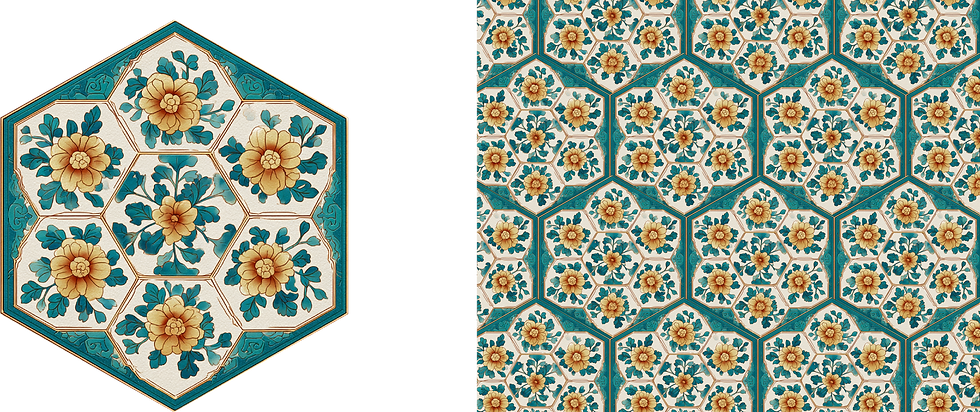
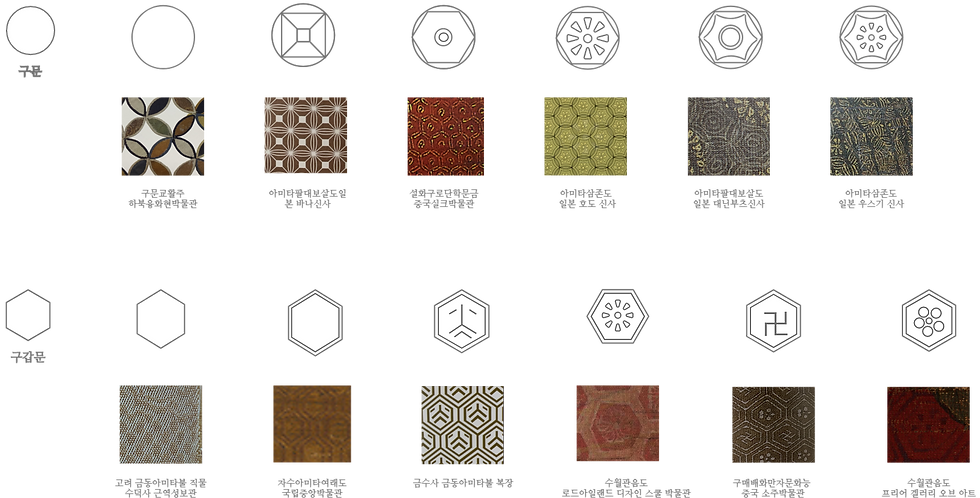
Motifs of the Goryeo Period
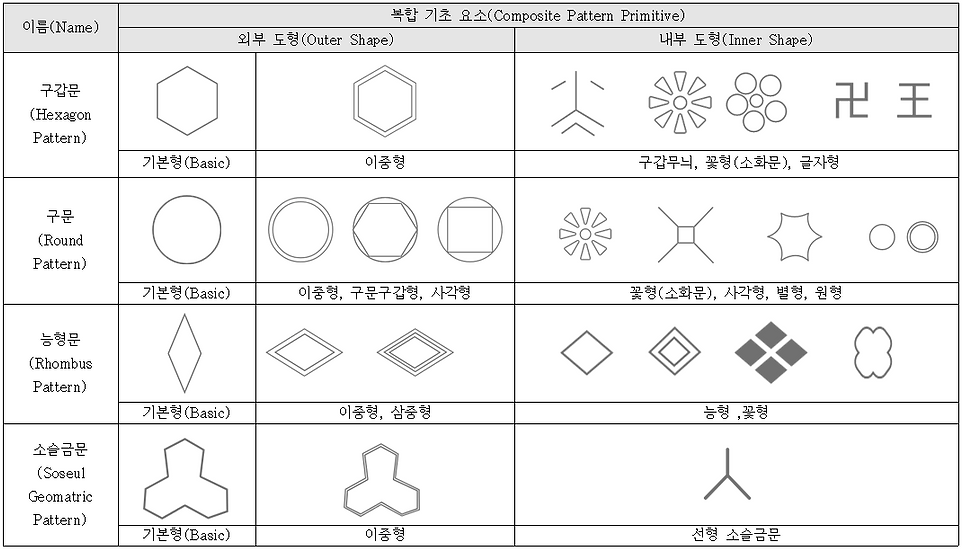
In previous research, approximately 250 surviving textile fragments from the Goryeo period were analyzed in order to identify and extract the geometric forms and motifs used within the patterns.
Previous Studies on AI Prompting Current prompt-generation methods are largely influenced by the limitations of AI tools and their dependence on pre-trained datasets. Therefore, a key issue is determining how much contextual and experiential information should be reflected in the training data and prompts.
In existing studies related to pattern design, prompt-writing methods have examined factors such as those shown in the table below. The conventional approaches to constructing prompts are as follows.
Prompt | Gioometric (Kunio Kondo 2024). | pattern primitive | Motif | Motif+ Data learning | Role play (online hack) | Ask How to make AI |
Description | Directly inputting geometric information in a mathematical manner. | Describing the pattern as a single unified surface or panel. | Specifying the motif used in the pattern. | Training the AI with target reference images and then applying the motifs. | Assigning a specific “role” to ChatGPT and instructing it to perform the task accordingly. | Asking a language-based AI which method would be most effective for generating the desired result.
|
AI Usage Area | LLM | LLM | LLM | LLM+ Image data learning | LLM
| LLM for LLM |
비고 | Does not function effectively with highly complex images. | Has difficulty understanding certain characters, such as Chinese characters (Hanja). | Produces only a single motif as the output. |
|
Based on the findings of previous studies, a prompt script was developed by combining the Motif, Geometric, and “Ask How to Make” approaches.
Prompt writing for Design Motif
The forms and designs of the Goryeo period were originally named using Chinese-character–based terminology. Therefore, this study carried out a process of modernizing these historical names by translating and adapting them into both English and contemporary Korean for use in design prompts.
Most generative AI systems tend to demonstrate better performance and responsiveness when operating in English rather than Korean, making this translation and adaptation process essential.
In addition, the prompts describing visual forms and structures were continuously refined. During the prompt refinement process, the prompts were repeatedly tested within generative AI systems, and then adjusted to produce outputs with more consistent and visually similar design characteristics.
Name | Pattern shape | Design motif Prompt | result |
구갑문 (Hexagon Pattern) |
 | Inside each hexagon tile: a minimalistic flat-line motif (or leave the tile blank for negative-space simplicity), consistent outline stroke, uniform thickness, crisp clean edges. | 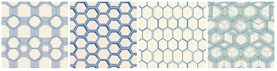 |
 | stylized swastika-like (卍) geometric emblem enclosed in a regular hexagonal border tile. The emblem and border lines are uniform in stroke width, with clean, crisp edges — no shading, gradients, or texture noise. |  | |
구형 (Round Pattern) |  | simple round, All lines equal stroke clean outlines, no shading, no gradient, no texture noise. |
 |
 | a symmetric geometric emblem composed of interlocking curved-line arcs forming a stylized square/diamond inside a circle or rounded-square frame (based on the provided motif). All lines equal stroke width, crisp clean outlines, flat vector-style line art no shading, no gradient, no texture noise |
 |
AI Prompt Rules
The prompt-generation rules used in this study are as follows. These rules were developed by combining existing approaches for “pattern image generation” with methods and recommendations suggested by AI systems themselves.
Basic introduce | 어떤 결과물을 내보내고 싶은지에 대한 설명 아래의 문구를 공통적으로 사용함 Seamless repeating fabric pattern. |
Design motif: | 반복할 도형에 대한 설명으로 위의 표 참조 |
Layout: | 어떤 규칙으로 나열할 것인가에 대한 설명 방사형 :the tiles are arranged in a strict hexagonal lattice, each hexagon tile repeating periodically across the plane to form a continuous, gapless tessellation. 정방형: |
Color scheme: | 어떤 색상을 사용할 것인가에 대한 설명으로 아래 문구로 청자색을 공통적으로 표현함 motif lines and border in soft celadon-blue (light jade / 청자색-톤), background in very pale cream or off-white to subtly contrast. High contrast but soft traditional-ceramic vibe. |
Style: | 스타일에 대한 설명, 다른 요소들이 학습 내용에 끼지 않도록 함. flat vector-style line art, minimalist, clean and balanced, pattern suitable for textile printing, clothing, or upholstery. |
Output: | high-resolution seamless tileable pattern ready for textile design. |
Prompt Generation Results
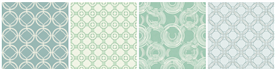
By applying and modifying motifs within the prompts, the following results were generated.
During the process, outputs containing biased or unintended visual characteristics were gradually filtered out, and the selected results were continuously refined and improved.

Results of the Modernization Process
The generated results were visually usable forms; however, for practical application, additional refinement processes were required, such as adjusting the borders to enable PRU application and removing backgrounds.
By modifying the motifs within the prompts, the following results were generated.

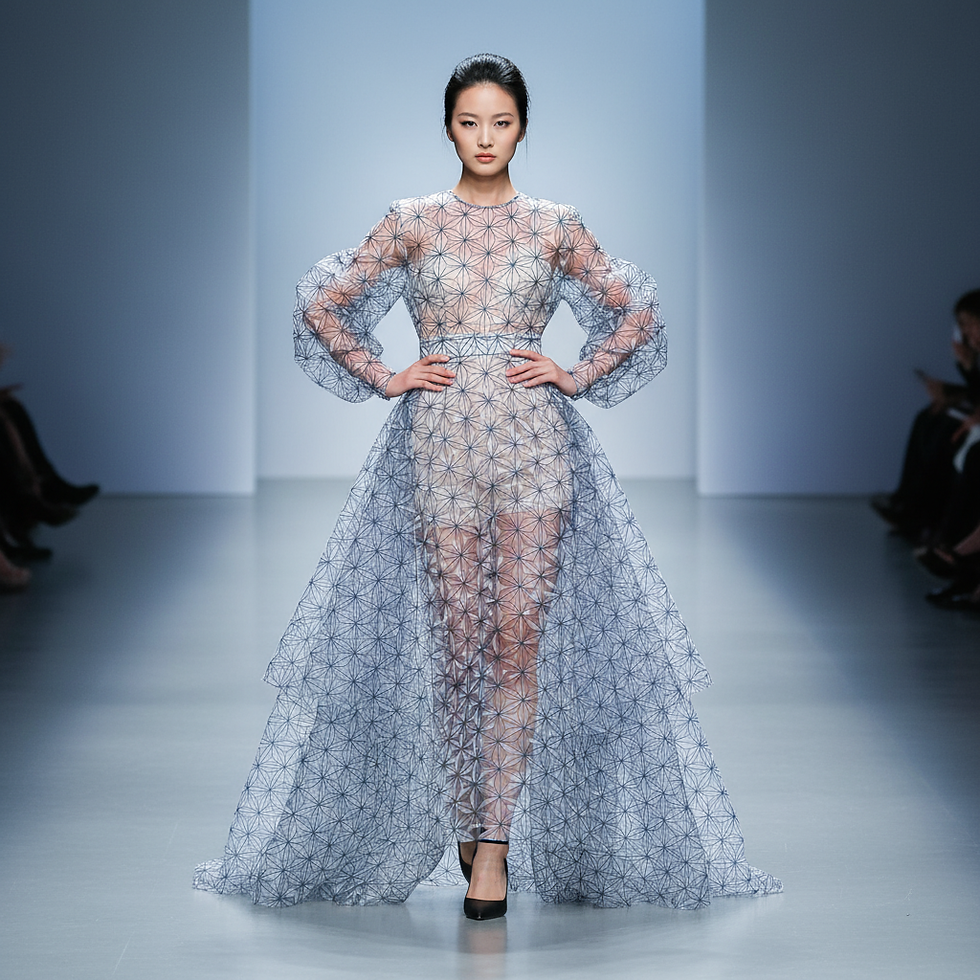
In addition, the generated results were converted into prompts for generative AI to create clothing designs, confirming their potential applicability to actual fashion and garment design.

Keypoints of UX
Rather than using generative AI simply to create experimental designs, the key objective of this study was to generate designs that matched the forms and intentions desired by the designer.
In addition, a major focus of the process was the continuous modification and refinement of prompts in order to produce outputs in a condition suitable for practical industry application and further design processing.


Comments